Sberbank CEO – Leader that created change

The manager’s qualities are not only measured by level of technical skills or expertise in the subject, but as to what extent every manager is a leader. Some scientists like Mintzberg even do not accept a distinction between the manager and the leader arguing that only leaders can manage efficiently (Mintzberg, 2009). Nevertheless, this blog will explain and discuss contemporary leadership theory at a closer glace and discuss on a case of Sberbank CEO and Chairman of the Executive Board (Sberbank, 2020) what value strong leadership has for an effective change.
Evolution of Leadership Theories
The nature of work in organizations was changing and the focus mowed from directional commands, achieving results by being controlled into a teamwork behavior. It includes coaching, support and empowerment. Consequently, the value of leadership and emphasize on it were growing (Mullins, 2016). Earlier view, emerged in the first half of the twentieth century and proposed by Kurt Lewin, distinguished three main leadership styles (the way in which the functions of leadership are carried out):
- Autocratic style: centralized authority, low participation
- Democratic style: involvement, high participation, feedback
- Laissez faire style: hands-off management
(Robbins, 2012)
However, the understanding of leadership theory evolved in order to meet modern realities. The change happened because of various factors such as: globalization, improved education level and overall technology progress. As a result, contemporary view on leadership started to distinguish two types transactional and transformational. According to Robbins the first is – leaders who guide or motivate their followers in the direction of established goals by clarifying role and task requirements. The second is – leaders who inspire followers to transcend their own self-interests for the good of the organization by clarifying role and task requirements (Robbins, 2012).
(Culture and Leadership, 2015)
About Contemporary Leadership Styles
Transforming leaders have very strong values. Leaders of this type are more likely to educate people using their values and help them grow professionally to achieve the required results. In order to attract followers, a conflict can be used that helps to elevate people up and help them reconsider their own values and needs (Day, 2012).
Bass understood transactional leadership as based on conditional compensation. It takes place by rewarding in return for meeting performance levels agreed with the leader. The intervention of a leader in this case occurs only when the agreements or established standards are not respected (Bass, 1993). Transactional leadership appeals to the self-interest of followers. It is based on a relationship of mutual dependence and an exchange process of ‘I will give you this, if you do that.’ (Mullins, 2016)
The table below summarizes the opposite traits of the two leadership styles:
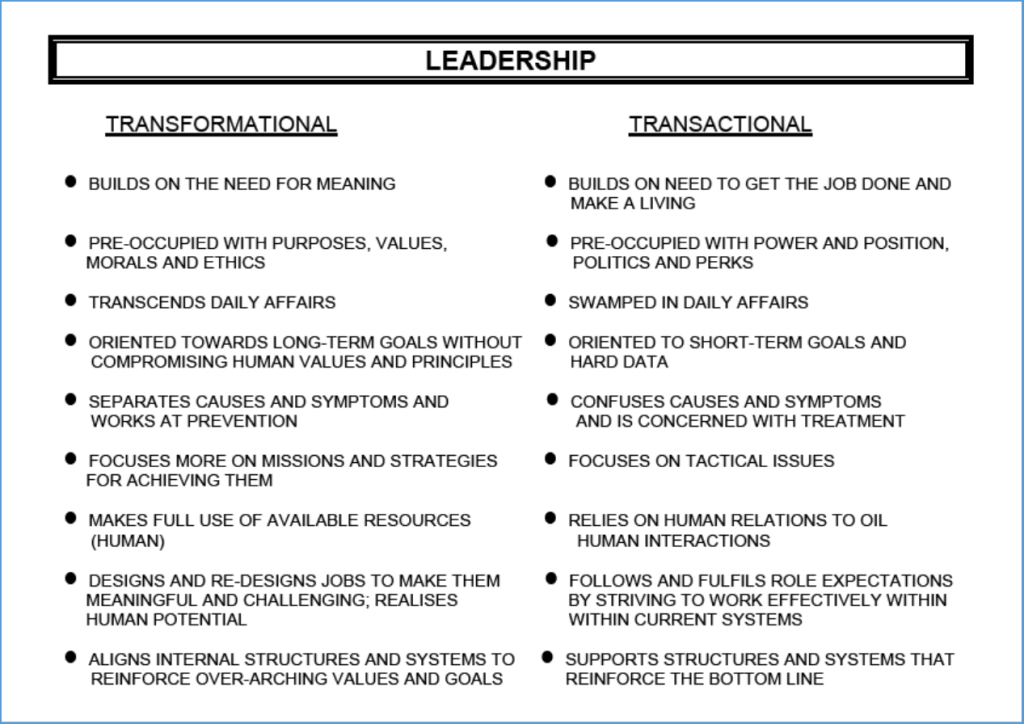
Both contemporary styles can be criticized; for instance, critics question the ethics of the very idea of transformational leadership. Keeley argued that transformational leadership is well and good as long as you assume that everyone will eventually come around to the values and goals of the leader (Kelly, 1992).
According to Mullins many writers see transformational leadership the same thing as charismatic or visionary, but arguably those two can be considered as a new approach of leadership (Mullins, 2016).
- Charismatic – An enthusiastic, self-confident leader whose personality and actions influence people to behave in certain ways.
- Visionary – A leader who creates and articulates a realistic, credible, and attractive vision of the future that improves upon the present situation.
(Robbins, 2012)
Association of leaders with vison and inspiration is increasing, its extent can measure the success of a transformational leadership (Mullins, 2016).
Role of a Leader for a Change
Evans suggested that leadership style can be chosen, and the choice is usually based on assumptions made by the selector. The factors for the choice are assumptions about people and organization itself. It has an important implication on team members, which leadership style is used. The reason of its importance is that it will create organizational culture and define most of the processes such as: decision making, supervision and organizational change (Evans, 1996).
In this blog we will discuss example of a leadership on Sberbank CEO and Chairman of the Executive Board Herman Gref (Sberbank, 2020). Over the 12 years of German Gref’s leadership, the oldest bank in Russia has made a real technological breakthrough and turned into a modern financial structure with a developed service system that is worthy of competing in the global banking market (Glavportal, 2019).
Sberbank CEO sees the main challenge for him today as the management of change which should happen faster than the environment changes (Ivanyushchenkova, 2016). One of Mr. Gref’s statements about himself is: “We very often try to change the world around us … The most important tool for changing the world is you yourself. A simple thesis: if you want to change the world – start with yourself, forget about any changes around” (Izvestiya, 2019). Mr. Gref emphasizes that true leaders should engage in self-development and be able to interest followers in his activities. According to the head of Sberbank, the ability to infect people so that their eyes “light up” so that they want to “become like you” is extremely important, but extremely difficult (Izvestiya, 2019).
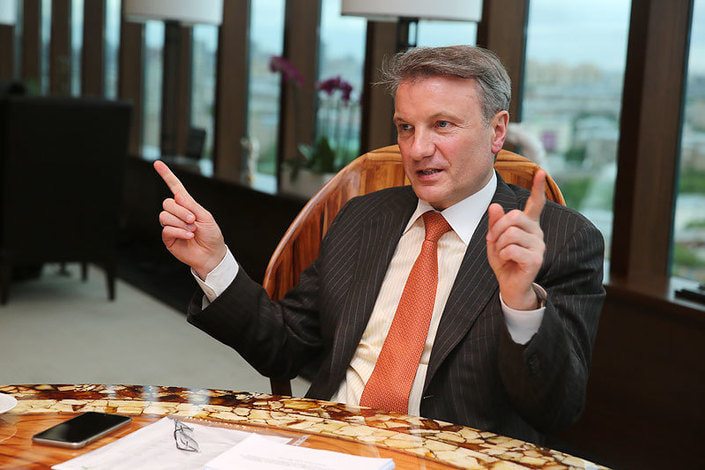
As a leader Gref is characterized controversially. Forbes wrote about Gref that with his legendary ability to work, working 16 hours a day, he plunged into the affairs of Sberbank and first of all set three goals: to become a banker, create a team and focus Sberbank on effective work (Forbes, 2019). Alexander Torbakhov, the former head of the Retail Business block, explained: “I have met many prominent people, but Gref’s personality is unique in both positive and negative sense!” It is not easy to work with such a leader as CEO of Sberbank. He not only works hard and expects the same from others but is also very self-confident and words things strongly (Forbes, 2019). However, one of the CEO’s deputies says: “The fascination of what we do with him at Sberbank compensates for all these inconveniences” (Forbes, 2019).
Conclusion
The leadership theory is evolving and will further progress to satisfy the needs of the changing environment. As well as new characteristics emerge to explain the nature and variety of leader’s traits.
When we look at the Sberbank CEO case, apparently, Mr. Gref sees transformation as the most efficient and preferred way of leadership; however, he is balancing it with transactional approach, which might ensure faster and guaranteed results.
And what do you think of yourself as a leader?
References
Bass, B. a. A. B., 1993. Transformational leadership: A response to critique. San Diego: Academia Press, Inc..
Day, D. V., 2012. Ethics Effectiveness: The Nature of Good. [Online]
Available at: https://pdfs.semanticscholar.org/4923/6d315c7306c029f29c3efc7616c8740705ba.pdf
[Accessed 17 March 2020].
Culture and Leadership. 2015. [Film] s.l.: TED.
Evans, T. J., 1996. Transformational Leadership: Overview of a Human Resources Administrative Practice. [Online]
Available at: https://files.eric.ed.gov/fulltext/ED402640.pdf
[Accessed 17 March 2020].
Forbes, 2019. “Floppy empires are crumbling.” How German Gref changed Sberbank. [Online]
Available at: https://www.forbes.ru/karera-i-svoy-biznes/375607-nepovorotlivye-imperii-rushatsya-kak-german-gref-menyal-sberbank
[Accessed 18 March 2020].
Glavportal, 2019. German Gref: “The main thing today is the competition of management models”. [Online]
Available at: https://glavportal.com/materials/german-gref-glavnoe-segodnya-konkurenciya-modelej-upravleniya/
[Accessed 18 March 2020].
Ivanyushchenkova, M., 2016. German Gref: “The Russian management style is ineffective, but effective”. [Online]
Available at: https://hbr-russia.ru/liderstvo/psikhologiya/a17082
[Accessed 21 March 2020].
Izvestiya, 2019. Gref listed the qualities of a true leader. [Online]
Available at: https://iz.ru/856356/2019-03-14/gref-perechislil-kachestva-nastoiashchego-lidera
[Accessed 18 March 2020].
Kelly, R. E., 1992. The power of followership. New York: Doubleday.
Mintzberg, H., 2009. Managing. s.l.:Financial Times Prentice Hall.
Mullins, L. J., 2016. Management & Organisational Behaviour. Eleventh edition ed. Edinburgh Gate: Pearson Education Limited.
Robbins, S. P., 2012. Management. 11th edition ed. New Jersey: Pearson Education, Inc..
Sberbank, 2020. Sberbank Corporate Website. [Online]
Available at: https://www.sberbank.com/index
[Accessed 21 March 2020].
 Anton's Blog
Dear Anton,
Thank you for sharing this interesting insight on the leadership styles.
It is described 2 main types of leadership, transactional and transformational. In a way transactional leadership style may be interpreted as a self-centric, egoistic way to manage the people, however it is still focuses on delivering results for the business.
Do you think any of these styles can be clearly defined looking at a certain leader, or it is always a combination?
Do you see the transactional leadership style as a negative way to manage the people and business, or it is a fair way at a certain circumstance?
Which of these to mentioned styles you think are closer to your leadership style?
Thank you in advance for your comments.
LikeLike
Hello Tatiana,
Thank you for your question, which challenge me to think critically and give true answers. First, I would not try associating transactional leadership style with egoism or other characteristics, as something on the surface might differ from the inside. My other responses are as follows:
Question 1: In my opinion, one of the styles might be prevailing and then it is fair to characterize a leader with it. Nevertheless, it might depend on the situation or period where the observation was made. Circumstances might require a leader to use one or the other style more, as well as any leader is evolving and changing in the course of time.
Question 2: I find it fair
Question 3: It’s hard to judge about myself because the perception of followers might differ. I would rather characterize myself as transformational, but I was giving efforts to act transactional at certain occasions. I find it most efficient when leader can balance and adopt style to environment and individuals they are working with.
LikeLike
Blog well built and explained. Would like to ask you, throughtout ur previous work experience, which type of leadership do you think you might have implicated?
LikeLike
Thank you for your feedback, Ahmad
I appreciate that a lot. I would rather characterize myself as transformational, but I was giving efforts to act transactional at certain occasions. I believe the healthy mix is something good for a leadership approach
LikeLike
Hi Anton, the blog is own structured with new headings and well explained that the leadership and management are most probably coherent in nature and can’t be distinguished. You have mentioned that Sberbank CEO handles transformation leadership in conclusion but I don’t see any characteristics related to that. Could you give some explanation regarding that?
LikeLike
Thank you for your feedback, Mr. Raja
I appreciate that a lot. You challenged me with your question 😊 The conclusion states how Mr. Gref sees him (and he sees himself acting transformative), but the perception of people around him might differ. Therefore, unless we do a primary research on Gref, we can’t accurately define his preferred style. Nevertheless, the evidences and feedbacks of people form Sberbank rather characterize him as a mix of styles with a peculiar character.
LikeLike
Hello Mr. Anton, explained very precisely not only the traditional but also the contemporary styles of leadership. Do you think the style of leadership influences the culture of a particular organization?
LikeLike
Thank you for your comment, Mr. Bhavya
I appreciate it a lot. I do think it does, at the same time when the organization is that strong it can influence the leader back and change his/her approach.
LikeLike
Hi,Anton.
I like your article, which is clear in logic and concise in language.
With the theme of contemporary leadership, it effectively analyzes the evolution of leadership theories, the opposite characteristics of the two leadership styles, and the role of leaders in the reform. Finally, it gives a summary.
I’d like to hear your thoughts. How do you see yourself as a leader?
LikeLike
Thank you for your feedback, Emma
I would prefer not to see me as a leader as I never really aimed to be. Nevertheless, I was managing people and I can hope I was leading for them. My preference when leading someone is to mix and balance between the two main leadership styles (contemporary view).
LikeLike
Hello Anton,
The blog was clearly structured and started with the TED talk video which is an interesting video. And then you have provided the chart for transformational and transnational. As a reader its easier for me to understand. Will there be any changes of the leadership if the CEO changes and do they have plan to change leadership style in the future to get a better result?
LikeLike
Thank you for your feedback Mr. Rohit Zen,
If your question concerns Sberbank, I do think they might change the approaches in leadership if the current CEO/Leader is changed. I guess such huge organization need a charismatic leadership and any successor will have its unique approach.
LikeLike
Hi Anton,
Seems interesting to read that leadership theory has now contemporary view which is a way different form the early view. I have a question to you: Which leadership approach have you experienced during your carrier and what is your feedback to it?
LikeLike
Thank you for your feedback, Mr. Smirnov
I was lucky to have great leaders that gave me lot. What I experienced was usually mix and situationally dependent. I also observed that leaders were changing their approach and I was impacting that to a certain extent when acted the right way.
One of the leaders I followed was mostly transactional and it worked very rally well, as it pushed me to act at my discretion and develop myself to become capable for the task and granted responsibility.
LikeLike
Hi Anton
The leader of the company I worked for told me that the company had to make transformational management changes at each different environmental stage. Only in this way can we get out of the bottleneck and welcome the breakthrough of the next stage. Do you agree?
LikeLike
Thank you for your comment, Ms Carrie
Apparently, you had a smart leader and I assume he was right as transformational leadership creates that level of engagement necessary to accept and adopt changes. I think transformational approach also creates strong basis for future.
However, in my opinion, it’s always unfair to say that one leadership approach is more suitable than another because the application is what matters mostly.
LikeLike
Hi Anton,
Impressive Blog on Leadership styles.
I appreciate the way you explained the role of a leader for change.
What is your opinion on women as leaders and their role in bringing change ?
LikeLike
Hi anton, well explained and acquired knowledge from your both blogs. But do you think Sberbank can handle transformation leadership in future?
LikeLike
Thank you Ms. Lang,
Yes, I think they can. They really progressed a lot in everything else, so I see no boundaries for more cultural transformation within organization. Different sources also say a lot about the education programs of Sberbank, which will create a lot of skilled leaders for the organisation.
LikeLike