Sberbank: Changing Culture and Role of its Leader

What is Culture?
Egan G. gives following definition of culture – the assumptions, beliefs, values and norms that drive ‘the way we do things here’ – is the largest and most controlling of the systems because it affects not only overt organizational behavior but also the shadow-side behavior . . . (Egan, 1993). In a broader sense culture can be seen from national or organizational angles. This blog emphasizes on organizational culture in order to see what role it plays nowadays and how companies overcome challenges when they transform culture.
Defining Organizational Culture and its Types
According to Laurie J. Mullin organizational culture is a collection of traditional values, policies, beliefs and attitudes that create a context for everything individuals do and think in an organization.
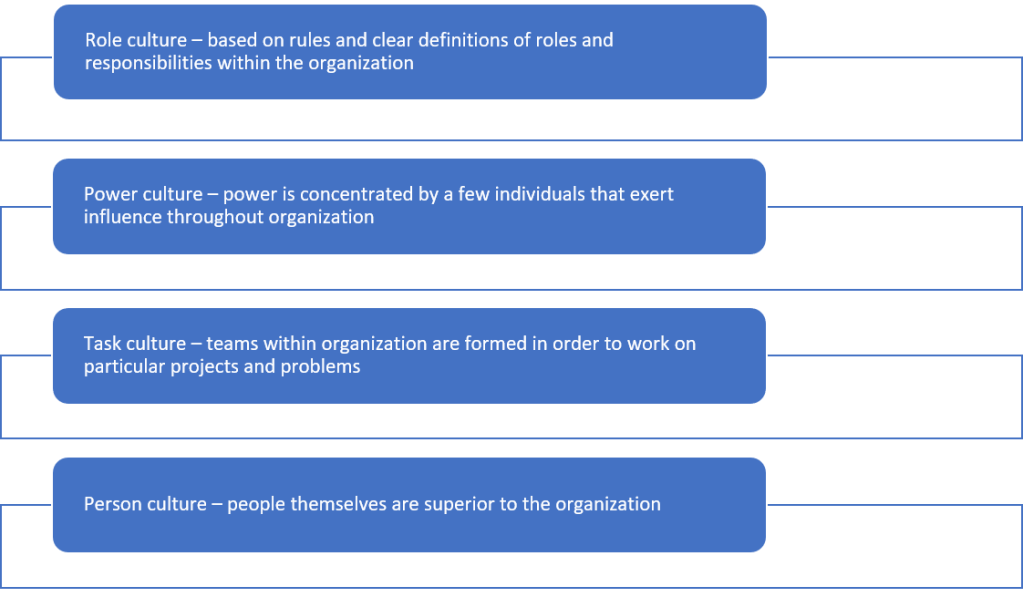
Companies must undergo regular transformations and changes in order to remain competitive and succeed in the rivalries. In order to be ready for change they have to diagnose their culture, health and performance, and the ability of the organization to adapt. As Mullins stated the leaders of the organizations need to be aware of the effects and impacts of organizational culture and climates within the teams (Mullins, 2016). Harrison Handy gives four main types of organizational culture: Power culture, Role culture, Task culture, Person culture (Handy, 1993).
Role of the Organizational Culture and its Background
The concept of organizational culture gains its importance every year as it directly impacts the success of modern public and private organizations. Companies can no longer afford ignoring it and organizational culture becomes one of the priorities. Its affect stretches from performance, sustainability to development of the business through ideas and implementations born within the organization. According to Arkhipova big companies try to develop and formalize its organizational culture through values, mission statement and code of conduct whereas by small enterprises it might still be present and formed by employees and management (Arkhipova, 2020).
Considering the fast progress and changes of the modern society companies have to adopt and change their cultures. Any running change in the organization needs to be in harmony with its organizational culture. Pillars for a success will consist of openness, participation and ability to accept new ideas (Mullins, 2016).
We will talk about Russian company, which demonstrated extraordinary progress and change achieved partly through its evolution of its organizational culture.
Sberbank Changing Culture
Sberbank a state-owned Russian banking and financial services company headquartered in Moscow that succeeded over the last years and managed to transform. According to Seddon Sberbank was considered an archaic and corrupt organization whose future wasn’t optimistic, and belief was that the situation might change (Seddon, 2018). However, years later even the Kremlin opposition leader Alexei Navalny admitted the improvements and efforts of the bank to undergo changes (Seddon, 2018).
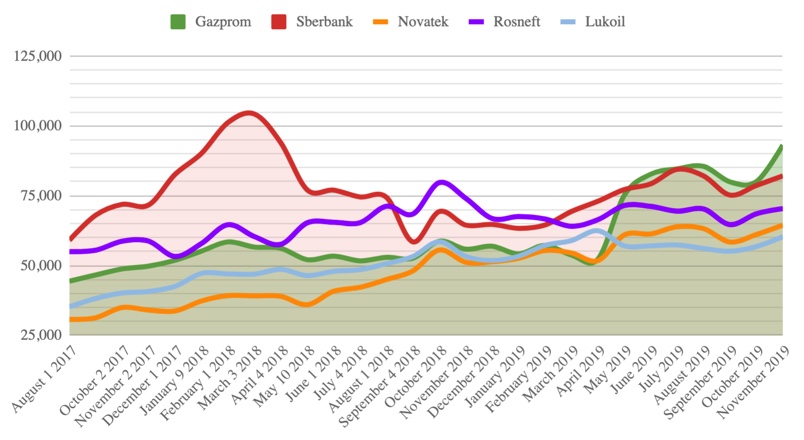
KINGS OF THE CASTLE: RUSSIAN STOCKS’ MARKET CAP (USD mn, end of period)
(Aris, 2019)
Sberbank is one of the leading financial organizations worldwide and is the largest bank in Russia, Central and Eastern Europe. Sberbank has a unique footprint in Russia with its 11 regional subdivisions and 14,200 branches that cover 83 Russia’s regions. Number of employees in 2020 is 278000 (Sberbank, 2020).
The changes of Sberbank over the last decade are noticeable and especially from the customers’ perspective. It’s no longer an old-fashion institution, but a modern financial services organization with an incredible geography in Russia in CIS. As any organization Sberbank has its unique culture, which has undergone transformation in the new century in order for organization to succeed. In fact, its culture might still be a mix of different types identified by Handy and each can find its example depending on the area within the organization. However, by Sberbank the prevailing form is a role culture with a strong authoritarian leader on the top. Sberbank clearly formalized its mission and values in order to achieve it and executes various of measures to sustain and develop the efficient culture.
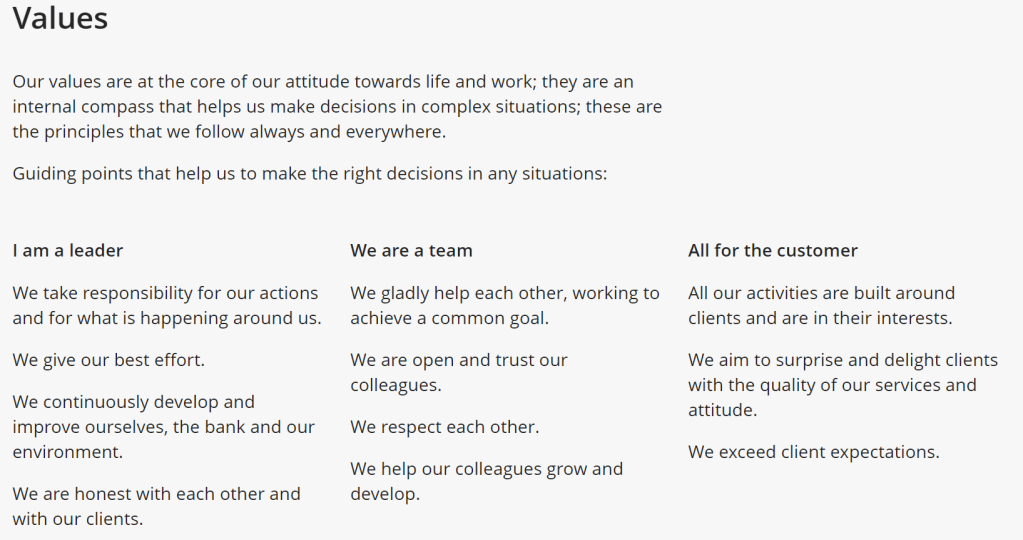
In the strategy for 2020 Sberbank sated that it aims to move from bureaucracy and rigid hierarchy to a teamwork, it had been earlier promised by deputy chairman of the board Yulia Chapurina on the management forum “Winning The Hearts”. According to Vedomosti the feedback of employees showed that corporate culture within the bank lacks humanity, respect, openness and cooperation (Vedomosti, 2017).
In its annual report for 2016 Sberbank emphasized on the role of culture and its development “The development of corporate culture is one of the key areas of Sberbank Strategy. This involves the formation of principles and norms of behavior that meet the mission and values of Sberbank, as well as contribute to the achievement of business goals” (Sberbank, 2017).
The goals set By Sberbank were oriented towards
- continuous feedback for team self-development and development;
- learning the basics of corporate culture and emotional intelligence;
- social projects, both employee-oriented and significant for society;
- the introduction of corporate culture in all HR processes.
Chernykh S. in his research “Corporate Culture in Russia” stated that corporate education was the main factor determining the philosophy of organization (Chernykh, 2017). He believes that formation of management culture determines the organizational culture and that the experience of Sberbank in changing corporate culture and launch of corporate education was significant. Sberbank officially opened its corporate university in March 2012 (Chernykh, 2017).
Sberbank – Role of the leader
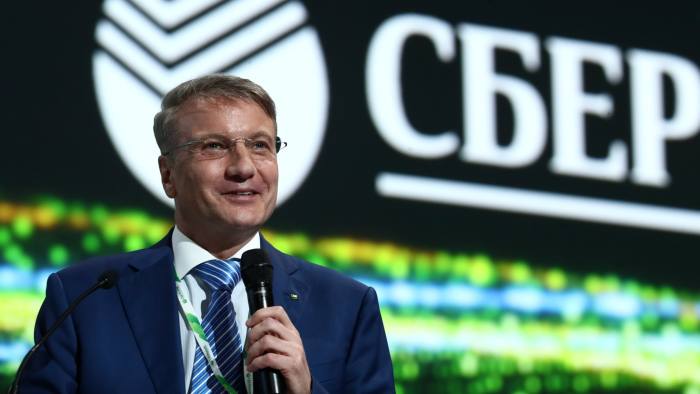
Herman Gref, the President, Chairman of the Management Board of PJSC Sberbank, Executive Director of Sberbank who is ruling the bank since 2007 played probably the key roles in changing and improving the organizational culture of the bank (Seddon, 2018). Following the initiatives of Herman Gref to fulfill the cultural revolution in the organization, the top management of Sberbank are making annual studies at Stanford University’s business school and visit start-ups. Mr. Gref himself was characterized as an autocratic manager ‘a benign, well intentioned dictator’ (Seddon, 2018).
As stated in Vedomosti the management style of Mr. Gref (the Chairman of the Management Board of PJSC Sberbank, Executive Director of Sberbank) is far from being agile and does not follow the trend of organizations where there is a lot freedom with less job descriptions and KPI (Vedomosti, 2017). It is rather a rigid vertical structure, locked on the personality of Gref. However, on lower levels, Sberbank managed to build a culture based on mechanisms oriented towards projects and tasks. Here Sberbank is way ahead of other banks (Vedomosti, 2017).
Historically being a liberal economist, Gref had to turn into an authoritarian ruler: he had to set the rhythm of change by his own example. “When you need to reform something efficiently and in a short time, you don’t need democracy. Perhaps you need a dictator. ” says one of the people close to Gref (Vedomosti, 2017)
Organizational Culture: What is next ?
The role of the organizational culture will sustain its trend and the importance of it will be acknowledged by more organizations. Companies give efforts to the formation and transformation of cultures because they understand the impact of this phenomenon.
The case of Sberbank illustrates that to a certain extent and as a matter of need the culture can be managed and undergo transformations even by such large and historically bureaucratic organizations. It also shows how a strong leader might play a crucial role to induce changes and execute cultural shift. In my understanding, leaders must lead the changes of cultures and Sberbank took the right way starting with education programs for its managers. I agree to the authors of “The Leader’s Guide to Corporate Culture” that the first and most important step leader can take to maximize value and minimize risks is to become fully aware of how organizational culture works (Harvard Business Review, 2020). This is applicable to Sberbank, whose educational programs should help its leaders to gain awareness and contribute to the further cultural upgrades.
Sberbank should pay attention to such aspects within organization as openness, respect and cooperation. Sberbank is on its way and should further transform the culture by upgrading upper levels to task oriented as it did for the lower level.

Sberbank Customer service point, Reception
References
- Aris, B., 2019. Russia Matters. [Online]
Available at: https://www.russiamatters.org/analysis/russias-stock-market-rallies-still-not-source-long-term-capital
[Accessed 22 February 2020]. - Arkhipova, O., 2020. Delat Delo: Online edition. [Online]
Available at: https://delatdelo.com/organizaciya-biznesa/korporativnaya-kultura-sberbanka.html
[Accessed 19 February 2020]. - Chernykh, S. I., 2017. Corporate Culture in Russia – History, Progress, Problems and Prospects. Canadian Center of Science and Education, 24 March.
- Egan, G., 1993. The Shadow Side. Management Today.
- Handy, C., 1993. Understanding Organizations. fourth edition ed. s.l.:Penguin.
- Mullins, L. J., 2016. Management and Organisational Behaviour. 11th ed. Harlow: Pearson Education Limited.
- Organisational Culture – Eats strategy for breakfast. 2018. [Film] s.l.: Ducere Global Business School.
- Sberbank, 2017. Annual Report 2016. [Online]
Available at: https://2016.report-sberbank.ru/ru/results-overview/employees/culture-and-development
[Accessed 16 February 2020]. - Sberbank, 2020. Corporate. [Online]
Available at: https://www.sberbank.com/about
[Accessed 19 February 2020]. - Seddon, M., 2018. Financial Times. [Online]
Available at: https://www.ft.com/content/3450c840-c0a4-11e8-95b1-d36dfef1b89a
[Accessed 16 February 2020]. - Vedomosti, 2017. What German Gref turned Sberbank into 10 years. [Online]
Available at: https://www.vedomosti.ru/finance/articles/2017/12/04/743989-gref-sberbank
[Accessed 22 February 2020].
Appendices
P.S.
I call readers to leave feedback and comment:
- What do you think helped Sberbank to overcome the transformation challenge and turn from a poor customers service public financial institution into one of the most developed and customers-oriented banks in Russia?
- How do you find the role of corporate education for creating a better and more efficient cultures?
- How do you find the role of a leader in the organizational culture?
- How do you change the culture around being a leader in the organization?
 Anton's Blog
It’s a wonderful blog which have a short and simple video about culture. The structure of how it was illustrated is clearly shows the impact of culture in an organisation. I was curious to know why the bank stock price was dramatically dropping in the year of 2018?
LikeLike
Thank you for your feedback, Zen. According to “Russia Business Today”, U.S. sanctions against Russia in 2018 drove investors away from shares of Sberbank. Therefore, Russian companies fell by 5-20% in a short period of time. More about the impacts in 2018 can be found here https://russiabusinesstoday.com/economy/sberbank-shares-attractive-for-investors-not-afraid-of-sanctions/
LikeLike
Very impressive blog on organisational culture.I appreciate the initiatives taken by Sberbank in bringing cultural shift based on the studies and analysis of its progress.In my opinion organisations should overcome the transformational challenges like Sberbank through good leadership,training managers and refresh the cultural values that meets the long-term goals of the organisations’ success.
LikeLike
It is a very useful blog clarifying the meaning of an organisational culture and it’s main types. The Sberbank example shows how the culture in the company might be changed and become more customer oriented. Moreover, it is a good practice to have own corporate university for top management team.
The development of organizational culture is really important for each company to achieve their main goals and become successful in the modern business world.
LikeLike
Thank you for your feedback, Maria. I am happy to read your expert opinion and I appreciate that.
Harrison Handy classified Organizational Culture by four Types: Role, Power, Task and Person. Which type do you think is prevailing in your organization?
LikeLike
Thank you for the feedback, Sunanada!
We recently worked in a group for the Strategic Management Assignment. To what extent would you agree with me that we managed to build a task culture within that group?
LikeLike
I agree with you Anton ! Building a task culture was essential for timely execution of work along with quality output as it impacted our assessments.
LikeLike
Dear Anton, I am happy to get your reply on my feedback.
As for my opinion, I see the combination of two types of organizational culture in our company: role and task types. Role type reflects in concrete roles and responsibilities which each member of a company has. They are clearly described and fixed for all of us. Task type is also observed as we have constant projects and tasks which are dedicated to concrete responsible teams.
It seems that many companies now have the mix of several types of organizational culture. It can open the more wide perspectives for development.
LikeLike
Your work emphasizes on how a great leader can transform any organization around. Would you say that national culture has a great influence on organizations and impacts the readiness of employees to undergo change?
LikeLike
Thank you for your question, Bhavya. Ed Hall formulated a framework for understanding cultural differences, which distinguishes ‘high’-‘medium’-or ‘low’-context society (Hall, 1990). It can be assumed that higher context would negatively impact the readiness of employees for change and its impact would need to be considered.
LikeLike
Hi ,Anton , the definition of culture was introduced in detail, and cases were given for analysis. In addition, various analyse the culture . The overall thinking was particularly clear, the language was fluent and easy to understand.
It is really a good articl. And i have a question, what culture model do you think is the most appropriate one?
LikeLike
Hello Emma,
Thank you for your feedback and your question.
Coming straight to answering it; in my opinion, the appropriateness of an organizational culture would depend on various factors, such as business environment, maturity of organization, its objectives and national culture. The last one can be researched closer by using the Geert Hofstede’ framework, which identified four dimensions: power distance, uncertainty avoidance, individualism and masculinity.
It means that depending on the extents within those factors a certain organizational culture type might suit better and service more efficiently.
LikeLike
Really liked how you strongly developed arguments into detail. What do you think the outcomes of this pandemic will have on the Russian Market in the coming months?
LikeLike
Hello Ahmad,
Thank you for your comment. I don’t have the right level of expertise to assess the impact of the pandemic onto the market. Nevertheless, I believe that Russian people and society are quite resilient because being in stress most of the time, and it might happen that we can stand it out with less losses than developed markets.
LikeLike
Hi Anton
it is very impressive blog!
I like the way you explained not only organizational culture but also pointed the role of the leader.
LikeLike
Thank you Ms Lang,
I appreciate your opinion
LikeLike
Hi Anton
I’m really really like your blog! Very logic by management, and expounds the culture change process. Enterprises in the development of the road, must pay attention to corporate culture management. I am curious to know what kind of culture do you like to follow?
LikeLike
Hello Ms. Carrie,
Thank you for such positive feedback that moved me. Regarding your question, I would say I like “task culture”. For me it’s clear when everything comes around a particular task and team is formed for it, it creates efficiency and transparency of the execution, there are now wastes or confusion about why and who.
LikeLike